How Python processes your code
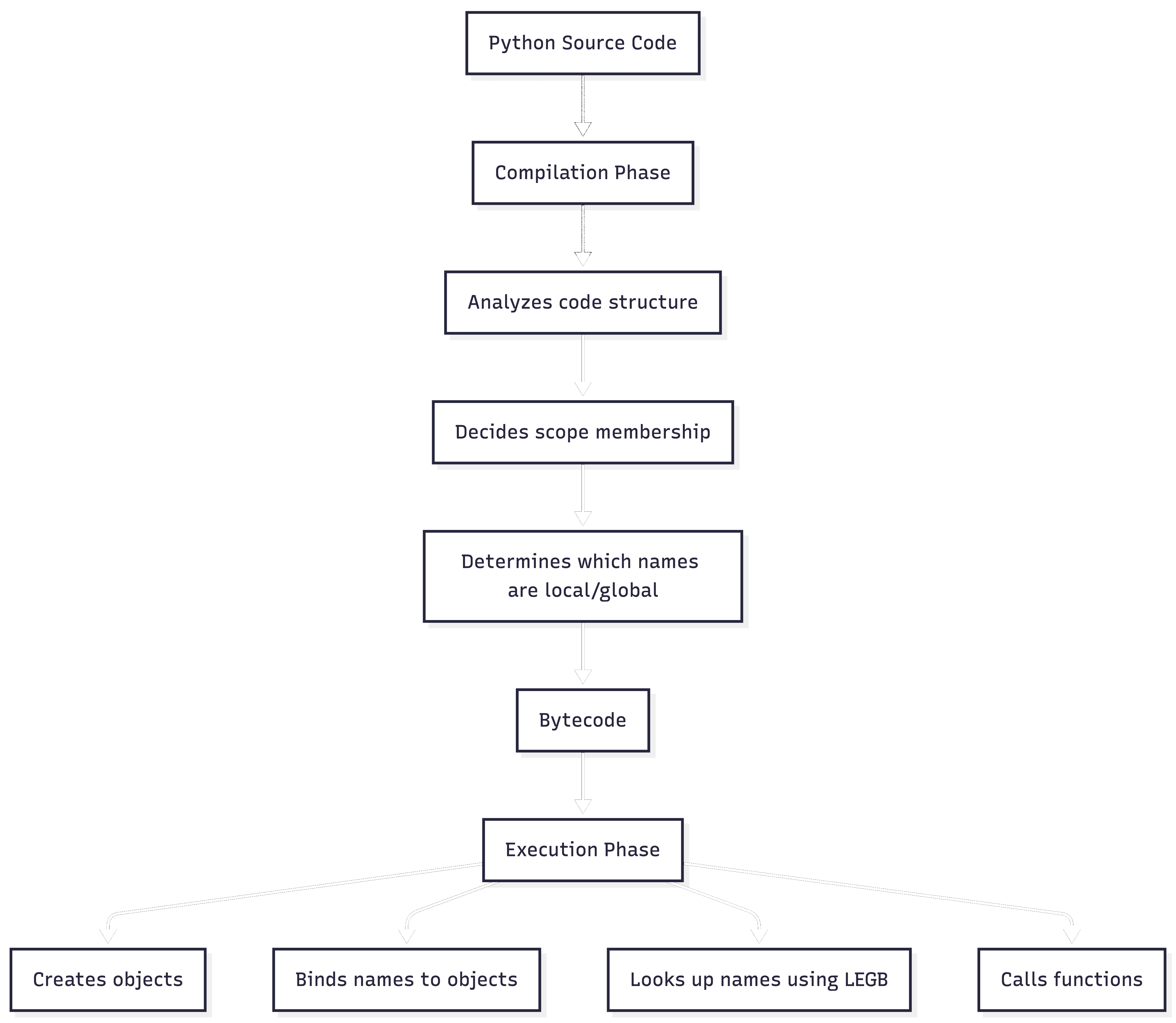
Python processes your code in two phases: compilation and execution. Understanding this split explains everything.
Compilation: What Python sees
Python executes code in two stages: compilation and execution. When Python compiles a code block (such as a module or function body), it analyzes the structure of the code. This includes where names are assigned, which names are referenced, and how scopes are nested.
def func():
    print(x)  # Is x local or global?
    x = 5     # Assignment makes x local
Python sees the assignment x = 5 and decides: "x is a local name in this function." This decision happens before the function runs.
Compilation determines:
- Which names are local
- Which names are free variables (used but not assigned)
- Which names are global
- The structure of scopes
Execution: What Python does
When Python runs your code, it executes the bytecode. During execution, Python:
- Creates objects
- Binds names to objects
- Looks up names using LEGB (see below)
- Calls functions
- Raises exceptions
LEGB is the lookup order Python uses to find names:
- Local — names in the current function
- Enclosing — names in enclosing functions (closures)
- Global — names at module level
- Built-in — names like
len,print,int
Python searches these scopes in order, stopping at the first match. If it searches all four and finds nothing, you get a NameError.
Execution happens after compilation. The decisions made during compilation control how execution behaves.
NameError vs UnboundLocalError
These two errors come from different phases:
NameError: Python looked everywhere (LEGB) and couldn't find the name.
def func():
    print(undefined_name)  # NameError: name 'undefined_name' is not defined
UnboundLocalError: Python decided the name is local (during compilation), but you're trying to use it before it's assigned (during execution).
def func():
    print(x)  # UnboundLocalError: local variable 'x' referenced before assignment
    x = 5
Why? Because Python saw x = 5 during compilation and marked x as local. When execution reaches print(x), Python looks in the local scope first, finds x exists (it's a local name), but it hasn't been assigned yet. Error.
This is why this works:
x = 10

def func():
    print(x)  # Works fine - x is free variable, looked up in enclosing scope
No assignment to x in func(), so Python doesn't mark it as local. It's a free variable, looked up at runtime.
How Python decides: local or not?
Python uses a simple rule: if a name is assigned anywhere in a function, it's local to that function. The assignment doesn't have to execute, it just has to exist in the code.
def func():
    if False:  # Never executes
        x = 5
    print(x)  # UnboundLocalError anyway
Even though x = 5 never runs, Python saw it during compilation and marked x as local.
This is why global exists:
x = 10

def func():
    global x
    print(x)  # Works - global tells Python: x is not local
    x = 5     # Modifies global x

func()
print(x)  # 5 (global x was modified)
# Output:
# 10
# 5
global tells Python during compilation: "don't mark x as local, it's global."
The global keyword
global changes how Python compiles your function. Without it, an assignment makes a name local. With it, Python skips the local scope and goes straight to global.
x = 1

def func():
    global x
    x = 2  # Modifies global x, not creating a local

func()
print(x)  # 2
During compilation, global x tells Python: "when you see x in this function, don't mark it as local—it's a global name." During execution, assignments to x modify the global scope.
Without global:
x = 1

def func():
    x = 2  # Creates a local binding
    return x

func()  # 2
print(x)  # 1  (global unchanged)
Python sees x = 2 during compilation and marks x as local. The assignment creates a local binding, leaving the global x untouched.
You can use global even if the name doesn't exist yet:
def func():
    global x
    x = 10  # Creates x in global scope

func()
print(x)  # 10
global is a compile-time directive. It changes how Python analyzes your function, not how it executes.
Compilation vs execution: The mental model
- Compilation analyzes code structure and decides scope membership
- Execution creates objects, binds names, and looks up names
- Scope decisions are made at compile time
- Name lookups happen at runtime
globalchanges compile-time decisions about scope
This split explains:
- Why
UnboundLocalErrorexists (local name used before assignment) - Why
globalis needed (it changes compile-time scope decisions) - Why scope is lexical (determined by code structure, not call site)
Everything in the names, binding, and scope guide follows from this two-phase model.